Table of Contents
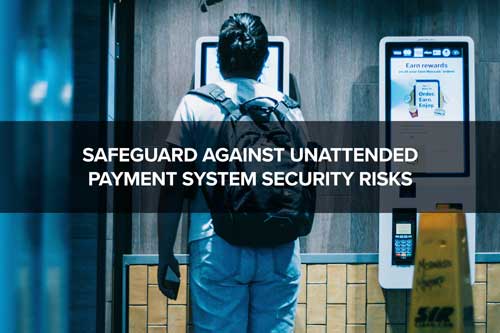
Kiosk Industry calls 2026 a “scale year” for unattended payments. Merchants have tested their theories and proven their concepts. Unattended payments have become core features of EV charging, vending, parking, transit kiosks, and self-service. However, the convenience of unattended payments systems comes with security risks. As businesses look for partners to help them scale their unattended payment systems, ISVs and VARs can differentiate their businesses by meeting the growing demand with unattended payment systems complemented with security solutions.
How to Overcome Challenges and Mitigate Unattended Payment Risks
Your merchant clients can’t guard against what they don’t understand. Educate them about the risks related to unattended payments and offer them solutions that help them safeguard their businesses and customer data:
- Fraud Prevention
An unattended payment device can be a tempting target for tampering. Although card skimming has decreased since EMV, the value in copying data from a magstripe, “shimming” is on the rise. This form of tampering uses a device that copies data from the card’s chip. Offer your merchants remote monitoring solutions that can alert them (or you if you provide managed services) that a device has gone offline or shows unusual activity. VARs can add value here by performing regular unattended payment device inspections to confirm they haven’t been tampered with and are working reliably. - Rugged Devices and Enclosures
Ruggedizing hardware and unattended payments devices with sturdy construction, high-impact glass, and weather-proof encasements protects assets from wear and tear and vandalism. VARs can also add value by advising merchants on where to place devices. Recommend that merchants find locations that are well-lit and highly-trafficked but also protected from weather, heat, and sunlight as much as possible. The right device construction in the right location will last, perform reliably, and keep total cost of ownership (TCO) low. - Video Surveillance
Depending on the application, merchants may want to deploy video surveillance solutions. For example, it may be beneficial to monitor EV charging and parking stations with video surveillance. AI-powered smart camera systems can monitor payment devices and trigger alerts or proactive actions if they detect unusual behaviors. - Remote Management
Deploying unattended payment devices in various locations creates uncertainty about uptime, unless you manage them remotely. When devices experience downtime, customer satisfaction and revenues decrease. Remote monitoring features of a payment terminal management system can increase uptime. This feature will send alerts when service is required, enabling support techs to address the issue before performance suffers.
The Key Is Balancing Risk and Reward
Merchants need the expertise that an ISV and VAR bring to the table in order to deploy the right unattended payment system supported by security solutions. You can add value by using your experience to help merchants ensure compliance, design a system with minimal complexity, and balance those requirements within their budgets. This increases the chances that consumers will have the best payment experiences and your merchants will be able to operate securely while still maximizing profitability.
To provide these solutions, you also need a partner with expertise in these systems. Contact us to evaluate options for your merchants’ use cases and how a Datacap partnership will help you differentiate your business by offering secure unattended payment systems.
FAQs
Unattended payment systems are vulnerable to physical tampering because they are not commonly supervised by humans. However, they can also be vulnerable to cyberattacks on their networks. ISVs and VARs should take a layered approach to security to address all attack vectors.
Just like taking a credit card payment at a checkout counter, unattended payment devices should use EMV technology, point-to-point encryption (P2PE) or end-to-end encryption (E2EE), and tokenization to secure data. It’s also necessary to monitor unattended payment devices remotely and immediately intervene if unusual activity occurs.
Yes. Some unattended payment devices have hardened enclosures, tamper-evident components, and locks. Some will even shut down automatically if they detect an intrusion.