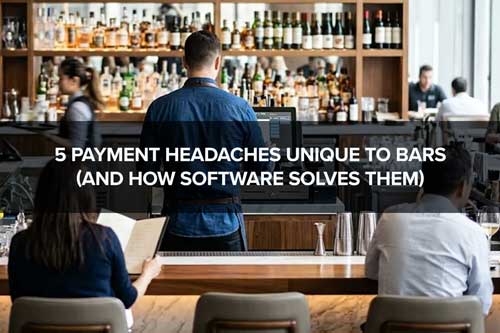
The U.S. bar industry generates roughly $39 billion in annual revenue as of 2025, a 12.8% annualized rebound since 2020, according to MMCG Investment Research. For the independent software vendors (ISVs) and value-added resellers (VARs) behind the point-of-sale (POS) software bars run on, that revenue passes through some of the toughest payment moments in hospitality.
Bars run payments differently from restaurants, and bar POS software has to keep up. The open tab, the pre-authorization hold, the tip added after the card has left, the big group splitting one check, the rush at last call. Each one is a place where general-purpose POS software shows its limits. Here are five payment headaches specific to bars, and the capabilities that solve them.
- Open tabs that grow all night, kept accurate with incremental authorization.
- Walked tabs and frozen cards, covered by card-on-file and an automatic gratuity rule.
- Tips added after the sale, captured through gratuity support before settlement.
- Group checks that need splitting, handled by flexible splitting in the payment flow.
- The last-call rush, cleared by fast capture and one reconciled batch.

 Keeping a tab accurate from the first round to the last call
A tab stays open for hours and keeps growing. The customer opens it with a card and keeps ordering, then settles at the end. The trouble is that a single authorization taken at open either holds too little to cover the final total or holds too much and risks declining a good card.
Incremental authorization lets bar software raise the authorized amount as the tab grows, so the hold tracks the real balance and the final charge clears cleanly. For your bar clients, that means fewer declines at close and tabs that reconcile without guesswork. For your platform, it means supporting the core bar workflow instead of shipping a workaround.
 The walked tab, and the card that gets frozen before you can run it
Some customers may leave without closing out, and more of them now freeze their card in a banking app on the way out the door. That can leave staff unable to settle the tab at the end of the night, and it is a growing problem on busy weekends.
Two capabilities soften the hit. Capturing a card on file when the tab opens, tied to a valid pre-authorization, gives the bar a credential it can charge even if the guest disappears. An automatic gratuity rule on tabs left open at close, now common across the industry at around 15 to 20%, keeps staff from being shorted on the tabs that do walk. Software that handles both protects a bar’s revenue and its tip pool.
 Gratuity support when the tip comes after the sale
Gratuity support lets staff add a tip to a sale that is already authorized, before the batch settles and without running the card again. At a bar, that matters because the sale and the tip often happen at different moments. The card is run to open the tab or cover the round, and the tip gets added later, at close.
This is a capability software has to build on purpose. When it is missing, bars fall back on manual math and voided transactions that raise their Payment Card Industry Data Security Standard (PCI DSS) exposure. Good gratuity support keeps the batch accurate and keeps staff out of the card data.
 Splitting checks on one group’s tab without doing the math by hand
A dozen people on one tab want to split it, and the way they want to split keeps changing as people leave. On software that only knows how to divide a check in two, that turns into a line at the register.
Flexible splitting handled in the payment flow lets the software divide a check by amount, by item, or by an even count, then run each portion as its own transaction. For your bar clients, that means faster turns and fewer errors. For a group of regulars, it is the difference between a smooth close and a frustrating one.
 Moving fast at last call without losing the thread
The busiest fifteen minutes of a bar’s night are also the most error-prone. Staff close dozens of tabs at once, often across more than one station, like the main bar and the patio. Payments have to clear quickly and still reconcile into one accurate picture at the end of the shift.
That calls for fast capture on saved credentials, with every station settling into the same batch, so speed at the register does not become a reconciliation problem the next morning. Reliability matters most on the busiest night, when a slow or failed checkout costs the most.