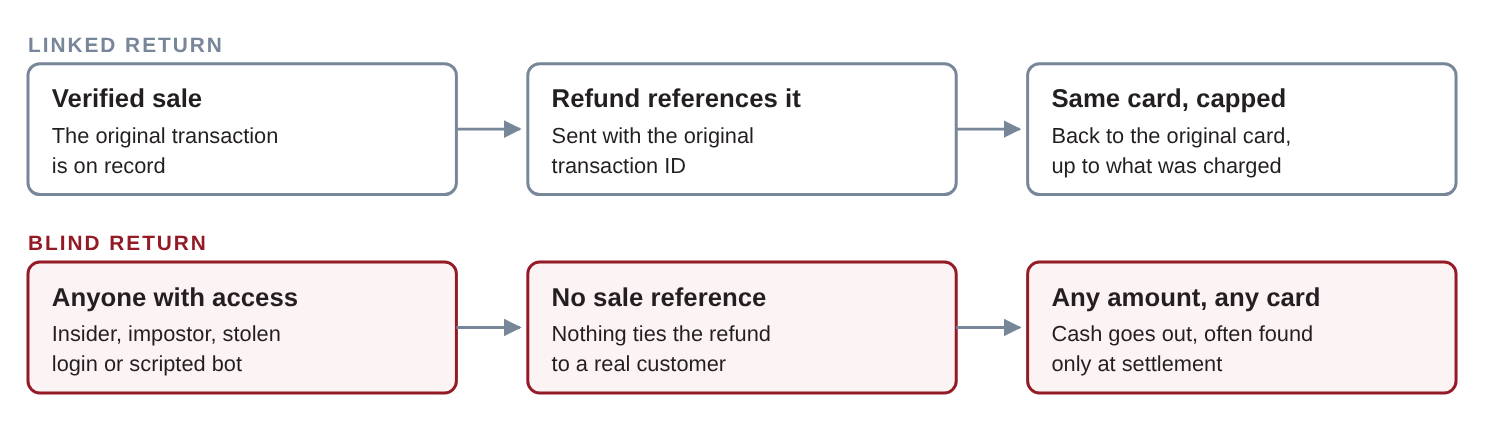
A blind return is a refund with no link to an original sale. It can send any amount to any card, so it is one of the easiest ways to turn a stolen credential, a compromised employee or a scripted bot into cash. Return fraud keeps growing, and AI now makes it cheaper to run at scale. That is why the payments industry is moving to linked refunds, which only go back to the card used for a verified sale, up to what was charged.
The numbers
Return and refund fraud is large, growing, and accelerating with AI:
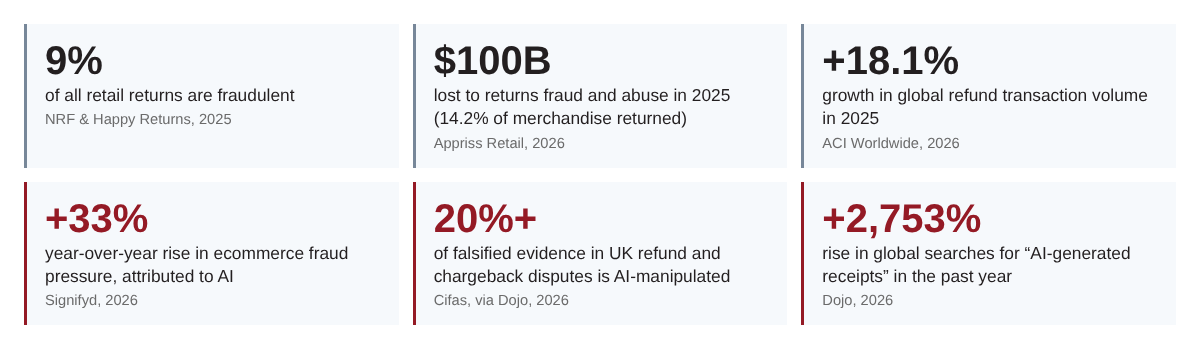
- 9% of all retail returns are fraudulent (NRF and Happy Returns, 2025).
- $100 billion was lost to returns fraud and abuse in 2025, 14.2% of all merchandise returned (Appriss Retail, 2026).
- Global refund transaction volume grew 18.1% in 2025 (ACI Worldwide, 2026).
- Ecommerce fraud pressure is up 33% year over year, attributed to AI (Signifyd, 2026).
- More than 20% of falsified evidence in UK refund and chargeback disputes is AI-manipulated, and global searches for “AI-generated receipts” rose 2,753% in a year (Dojo, citing Cifas, 2026).
Blind returns aren’t measured as a separate category. These figures show the overall pressure on refunds that a blind return leaves unguarded.
How blind returns get exploited
- Insiders. Employees who abuse POS access redirect refunds to their own cards. A common red flag is repeated refunds to the same card with no customer interaction to match (Adyen, Envysion).
- Social engineering. Callers pose as IT support, a payment processor or a district manager and talk cashiers into a manual, unreferenced refund to the caller’s card.
- Stolen credentials. If a POS login, a virtual-terminal login or an API credential is compromised, every blind refund it can send is cash out. Nothing caps the amount, and nothing ties the refund to a real customer.
- AI at scale. Generative AI makes fake receipts, damage photos and convincing support calls cheap to produce, so these schemes can now run in volume.
The industry is already moving to linked refunds
- Visa has required authorization of every refund since April 2020. A refund may go to a different account only if the original card is no longer valid or the issuer declines the refund (Visa).
- In a January 2026 reminder, Visa recommends checking that a refund goes to the card used for the original purchase and including the original transaction identifier. It warns that non-compliance fees may apply (Checkout.com).
- Major processors now advise merchants to “require linked refunds whenever possible” (Adyen).
Common pushback, answered
| Concern | Answer |
|---|---|
| “Our customers return items without a receipt.” | Look up the original sale by card, order number or loyalty ID and link the refund to it. If there is truly no record, issue store credit or a gift card. Card brand rules already allow that. |
| “The original sale is on another system or past our retention.” | Linking only needs the original transaction reference. If the sale really can’t be found, use alternate credit instead of sending money to an arbitrary card. |
| “We’ve never had a problem.” | Blind-refund fraud usually shows up only at settlement or reconciliation, and an AI-scaled attack can run through many refunds before anyone looks. |
| “It adds friction at the register.” | A linked refund is one lookup. It also prevents over-refunds and duplicate refunds, and it reduces chargebacks and disputes over refunds. |
Questions or need help switching to linked returns? Contact Datacap Integration Support at integration@dcap.com.