The Direction the Industry is Heading the Next Five Years
The ticket is becoming obsolete. Drivers who book travel online and order dinner from an app now expect the same speed and payment choice when they park, and parking payment friction consistently ranks among their top complaints. Facilities that remove that friction win repeat business. Those that don’t lose it to the garage down the street.
Over the next five years, AI, IoT, and transportation ecosystem integration will reshape how parking facilities operate: ticketless entry, LPR-triggered billing, mobile pre-booking, digital validation, and EV charging. Every one of those innovations ultimately depends on a transaction clearing in seconds, tokenizing cleanly, and reconciling into one report. Parking operators and the developers who serve them need a payment layer built for that now, not retrofitted later.
Download our free whitepaper or read the whitepaper contents below to see where the parking industry is heading and what it takes to be ready.
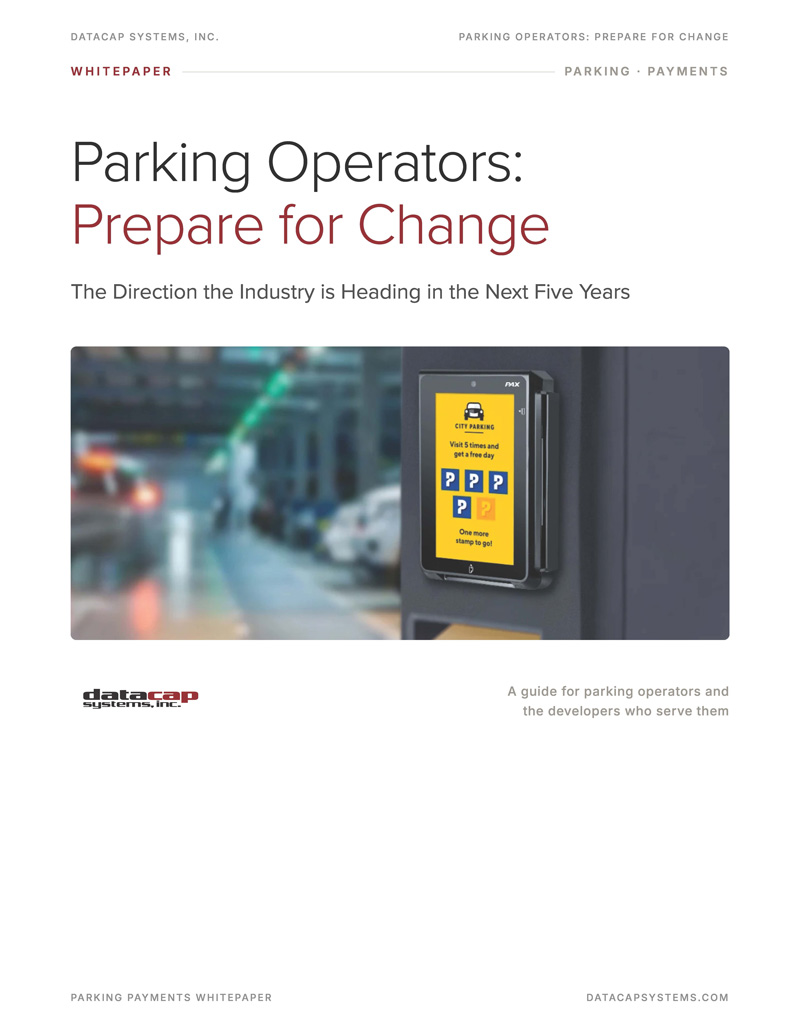
Parking Operators: Prepare for Change

The Direction the Industry is Heading in the Next Five Years
A guide for parking operators and the developers who serve them
What Do Drivers Expect from Parking Payments Today?
The drivers pulling into a parking facility today have different expectations than they did five years ago. As digital-first consumers, they’re accustomed to booking travel online, shopping on ecommerce retail sites, and ordering dinner with a restaurant app. Digital processes have made their experiences faster, more convenient, and more personalized, and they want the same types of experiences when they park.
Parking payment friction consistently ranks among drivers’ top pain points. Facilities that remove friction will win repeat business, and those that don’t will lose it to competitors. Filling parking spaces is essential for commercial parking facilities, but equally important for parking facilities that serve commerce centers, hospitals, event venues, or universities. Those businesses and organizations must ensure that the payment experiences in their parking facilities meet drivers’ demands and enhance, not detract, from their brands. Payment choice, convenience, transaction speed, and security are no longer differentiators. They’re the baseline for viable facilities.
Datacap published this guide to help parking facility operators and the solution providers who serve them bring payments up to date and lay the foundation for continued innovation as new technologies and driver behaviors evolve. It reflects Datacap Systems’ gateway technology expertise and the hardware and processor-agnostic architecture that makes omnichannel parking payments work.
Which Technologies are Transforming the Parking Industry?
Innovators continue to bring digital solutions to market to modernize parking facility operations to meet driver expectations while improving the bottom line. Three technologies are emerging as powerful forces to change the parking industry landscape:
Artificial Intelligence (AI)
AI has the power to streamline and automate operations, in addition to using data to make decisions that maximize revenues and profits. AI enables advanced capabilities, including:
Vehicle Identification
AI vision systems and license plate recognition (LPR) enable gate automation and safety monitoring.
Video Analytics and Predictive Parking
Intelligent cameras and gate data can track entrances, exits, and dwell time. The system can predict facility capacity and direct drivers to available spaces in real time.
Dynamic Pricing
AI can recommend or automatically adjust fees, charging premiums for event parking, time-of-day demand, and occupancy forecasts. Developers adding dynamic pricing as a solution feature need to work with a payment gateway that accepts variable amounts passed at runtime, with no hardcoded fare logic on the device.
Internet of Things (IoT)
IoT technology allows parking facilities to leverage sensors to create a connected network that enables remote monitoring of gates, kiosks, payment terminals, and other assets. Data and alerts from these sensors identify devices and equipment that need service, minimizing downtime and driver frustration. It also allows the facility to maximize revenue. A payment terminal that fails leads to lost revenue, so extending uptime monitoring to payment devices makes good business sense.
Transportation Ecosystem Integration
In a digital-first, connected world, parking can no longer be siloed from transit, taxi, or ridesharing services. Additionally, curb management for autonomous vehicles and delivery services is creating new revenue opportunities for parking administrators. Real-time data sharing will improve commuter experiences across the mobility ecosystem and maintain traffic flow. Payment infrastructure must be designed to integrate into these broader platforms, not just serve isolated transactions.
Current and Emerging Parking Facility Trends
To capitalize on the benefits of new technology and meet driver expectations, the parking industry is modernizing, with these trends gaining momentum:
Automated Entry, Exit, and Payment
 The ticket is becoming obsolete. Several solutions allow drivers to enter, exit, and pay with no ticket handling:
Card-In/Card-Out
Drivers insert a payment card to open the gate and again when they exit. Payment is collected on exit with no ticket necessary.
License Plate Recognition (LPR)-Triggered Billing
The system scans the driver’s license plate on entry. The driver types or confirms the plate at exit; the system displays the fee displayed, and the driver confirms payment. The system recognizes long-term parkers’ license plates and bills them via token-based recurring charges or payment links.
Developers offering these solutions must ensure real-time authorization, with latency measured in milliseconds. Efficient parking facility operation cannot tolerate gate lift delays due to data making a slow network authorization round trip. Payment gateway selection must take performance SLAs into account. Also, note that tokenization is the payment technology behind “remember my car.” Card data is stored as a secure token; no sensitive data lives in the parking system. This is required for recurring monthly billing and frictionless re-entry, in addition to Payment Card Industry (PCI) compliance.
Mobile Apps and Online Pre-Booking
Parking apps allow drivers to find, reserve, and pay for short or long-term parking before they arrive. The visibility that parking apps gives drivers eliminates circling to find a space and expired-meter anxiety, which is a key driver of parking abandonment. Parking apps have become popular for on-street and event parking, but parking garages are increasingly adopting them. Parking app payments require a gateway that handles card-not-present (CNP) online transactions with the same tokenization engine used for in-person payments, so a driver’s card stored in the app works seamlessly at the kiosk, gate, or validation desk.
Walk-Up Self-Service Kiosks
Walk-up parking payment kiosks are still prevalent, allowing drivers to pay inside a building and exit the parking facility with a code or validated ticket. Unattended kiosks must support full EMV chip, contactless, and mobile wallet acceptance, and transactions must be intuitive and seamless, since no employee is available to assist. Solution providers must work closely with their payment partners to build these solutions. The kiosk payment hardware and gateway must be certified together, so developers must understand the certified unattended devices that their payment partners support.
Developers must also acknowledge that payment choice at a parking payment kiosk is not optional. Drivers expect their preferred cards and wallets to be accepted here exactly as they are anywhere else they transact. Full network support is not optional.
Modern Parking Validation
Digital validation codes, mobile app integrations, and LPR-linked validation are replacing paper tickets for parking validation. Retail, restaurant, and hotel partners offering free or discounted parking as a reward or loyalty benefit will operate more efficiently and accurately with digitized processes.
In addition, network-linked rewards and card brand loyalty programs can be integrated with parking validation to offer cardholders incentives at partner facilities, a differentiator that can drive repeat visits to a parking facility. Solution providers need to apply validation discounts at the payment layer, before settlement, not as a manual rebate, so developers must confirm the gateway supports discount application via API parameter.
EV Charging Integration
Drivers will expect EV charging as an amenity in parking facilities within five years. Facilities without it will be at a competitive disadvantage. Charging is an additional unattended payment use case, requiring session-based billing, variable amounts, and card-on-file for returning users. Operators will benefit most when parking and EV charging run through the same payment gateway, enabling unified reporting, single reconciliation, and one integration effort for developers. A single, bundled parking and EV charging payment transaction is emerging and requires gateway-level support.
The Business Case for Modernizing Parking Facility Operations
Parking facilities at the decision point of whether to digitally transform their operations or to continue to operate with legacy processes need to consider the pros and cons. While upgrades require investment, there is a clear return that impacts multiple areas of the business:
Revenue Accuracy
Digital payment eliminates revenue leakage from unpaid meters or inaccurate time accounting. Every transaction is logged, time-stamped, and reconciled.
Reduced Labor Dependence
Automated payment flows reduce reliance on attendants and help facilities operate in a tight labor market.
Sustainability
Efficient operations help communities reduce circling to find a parking spot, cutting emissions and traffic congestion.
Safety
Connected systems can monitor facilities, alert operators and drivers to safety incidents, and facilitate faster incident response.
Operational Data
AI and IoT generate data that enables smarter pricing, maintenance planning, and capacity management.
Brand Protection
For a facility tied to a venue, hospital, or commercial property, payment failures and poor experiences reflect on the anchor brand.
The ROI will likely tip the scales toward the decision to upgrade to modern parking facility technology. However, parking facility operators will add to the business case if they consider total cost of ownership (TOC). With efficient, automated systems, daily operational costs and maintenance line items decrease and remain lower than with legacy processes, further supporting the business case to upgrade.
Optimizing Parking Payments: The Revenue and Experience Layer
Payment is not a back-office detail. It is the moment that determines whether a driver leaves satisfied or frustrated.
Every innovation described in this guide ultimately depends on a transaction. Payment is the moment that determines whether the operator captures full revenue. A payment platform that meets the needs of the parking industry must deliver the following:
Payment Choice that Drives Conversion
 Credit, debit, contactless, mobile wallet (e.g., Apple Pay® and Google Pay™), and pay-by-bank must all be supported. Drivers who can’t use their preferred payment method may leave and not return. Parking facilities should also accept payments from every major card brand. Facilities at airports, event venues, hotels, and healthcare centers serve an especially broad mix of domestic and international cardholders, and a card a facility cannot accept is revenue it cannot capture.
In addition to support for all card brands, payment facilities must allow drivers to make the payment in the way they prefer. Contactless payment adoption has skyrocketed in recent years, allowing consumers to pay more quickly, crucial during peak times. A tap-to-pay kiosk processes a transaction in under two seconds vs. 15 seconds or more for a contact EMV payment.
Omnichannel Architecture
Allowing digital-first drivers to move seamlessly from one channel to another when interacting with a parking facility is essential. A driver may pre-book online, tap at a gate, pay at a kiosk, or use a mobile app, all in the same visit. The parking facility’s payment platform must handle all channels through a unified token and transaction record. Separate gateways for different channels create data silos, reconciliation headaches, and broken experiences when a token from one channel fails in another.
Additionally, parking facilities need to retain the flexibility to continue to adapt to technological advancements and changing consumer demands. Processor-agnostic and device-agnostic gateways allow operators to change acquirers or upgrade hardware without re-integrating.
Security and Compliance
A parking facility’s payment gateway must support payment data security for compliant operations and consumer protection. Must-have security capabilities include:
Tokenization, which replaces card data with a secure token. The parking system never stores a primary account number (PAN), which dramatically reduces payment data vulnerability and Payment Card Industry Data Security Standard (PCI DSS) scope.
Point-to-point encryption (P2PE) protects data from card swipe or tap through to the processor. With P2PE, even a compromised device cannot yield usable card data.
Network-level fraud monitoring and cardholder liability protections add another layer of assurance for drivers, which operators can use as a marketing differentiator.
Operators should ask any payment partner if they provide a validated P2PE solution and how integration with their platform will impact PCI scope.
Reporting and Reconciliation
Parking facilities should demand that their payment partners offer unified reporting across all payment channels (gate, kiosk, app, online) in a single dashboard. The gateway should enable revenue reports by time of day, location, and payment type, which is the data that operators need to make pricing and capacity decisions.
Parking facilities will also benefit from dispute and chargeback management tools that reduce the administrative burden on parking staff to handle the chargeback representment process (responding to disputes with evidence).
What Parking Operators Should Expect from a Payments Partner
Parking facility operators and the developers who provide them with modern systems that help them run must recognize that not all payment solutions are suited for the parking industry. For example, a generic gateway wasn’t designed for unattended kiosks, LPR-triggered billing, gate latency requirements, or validation splits. When evaluating a payments partner, operators should demand the following:
Parking-Specific Integration Experience
A payments partner should be able to prove successful integrations with parking facility software and have a clear integration path, including card-in/card-out gate integration. The gateway should be capable of handling LPR-triggered token billing without a physical card present at the time of charge.
Full Card Network Acceptance
The payments partner should work with every major card network, i.e., Visa, Mastercard, Discover, Diners Club International, and American Express. Global network acceptance is especially important at airports, hotels, and facilities that serve international travelers. Anything less than the full slate of card network acceptance will mean lost revenue. Solution developers should confirm that network acceptance is certified on the specific devices and form factors deployed in the parking facility rather than just on paper.
Support for Every Device Parking Operations Use
Parking is unusual in its device diversity. A single facility may transact at unattended pay stations, gate entry and exit readers, attended countertop terminals at manned booths, handheld mobile devices for roving attendants, in-lane pay-by-phone and QR integrations, online pre-booking portals, and EV charging payment terminals, often simultaneously. A payments partner must hold certifications and active support for all these form factors. Furthermore, the payments partner should also be device-agnostic, which means it isn’t affiliated with a specific hardware brand that locks the payment facility into choosing devices from only one vendor’s catalog. A hardware-agnostic gateway will give the facility the freedom to choose the best device for the use case based on budget, form factor, and durability, and the best way to operate and maximize revenue.
As new payment form factors emerge, such as biometric payment authentication, vehicle-linked payments, and wearable payment devices, a device-agnostic gateway will adapt without a full integration rebuild.
Processor-Agnostic Architecture
Payment facility operators should also be careful not to become locked into a single acquirer. The ability to switch processors protects negotiating leverage on rates and gives flexibility if a processor relationship changes. A processor-agnostic gateway gives payment facilities this freedom, but it also means operators can work with regional or specialized acquirers who may offer better terms for parking-specific transaction profiles (e.g., high-volume, low-dollar, and card-not-present transactions).
Parking facility operators should ask prospective payment partners what migration to another acquirer would look like if they should choose to switch in future years. A partner worth having will provide a clear answer that involves minimal friction for the facility.
Resilience: Store and Forward for Connectivity Outages
Parking facilities are especially vulnerable to connectivity disruptions. Connectivity issues in underground garages, event surges, and ISP outages can all take a payment gateway offline. When a network disruption occurs, a facility without a resilience strategy will entirely stop collecting revenue.
Store and Forward functionality captures transaction data locally on payment devices when the network is unavailable, then processes those transactions automatically once connectivity is restored. For operators, this means gates stay functional, and kiosks keep accepting payment even during an outage. Attendants don’t need to scramble with manual processes or reconcile revenue gaps later.
For developers to include Store and Forward capability in the solutions they provide, they must have gateway-level support. It is not something that can be bolted on at the application layer. Developers should confirm the gateway partner supports Store and Forward natively, with configurable floor limits (a maximum transaction amount accepted in offline mode) and automatic reconciliation on reconnect.
A payment gateway with parking industry experience will be able to explain their offline payment strategy, including duration and transaction limits before the device requires reconnection.
Loyalty and Validation Program Support
Validation discounts, loyalty reward redemption, and partner-funded free parking all require payment-layer logic, not manual workarounds. Card network rewards programs let operators at qualifying locations participate in network-linked incentives, creating differentiation and repeat-visit loyalty. Confirm the payment gateway partner applies discounts via API at transaction time, with an audit trail, not as post-settlement adjustments.
Developer Considerations for Payment Integration
For parking software developers, payment integration decisions made early have long operational consequences. Developers need to get these elements of parking payments right from the start.
Semi-Integrated vs. Fully Integrated Architecture
In general, developers can integrate payments with parking management software in two ways:
| Semi-Integrated | Fully Integrated |
|---|---|
| The payment device captures and encrypts all card data and routes it straight to the payment gateway. The parking application never sees a card number; it receives an approved/declined result plus a token and receipt data. Card data stays out of the parking software entirely, keeping it clear of cardholder-data scope and cutting the operator’s PCI burden dramatically. | Card data flows through the parking application, pulling it and everything it connects to into the cardholder data environment. The operator faces a full PCI DSS assessment, and the software itself may require validation under the PCI Secure Software Standard. |
RECOMMENDATION: Semi-integrated is the right choice for the vast majority of parking software implementations. It moves faster, reduces compliance burden, and is supported by leading gateway providers, including Datacap Systems.
EMV Certification and Device Support
Developers should confirm that the payment gateway has certifications that cover all payment types on each device that parking facilities use: EMV chip, contactless, NFC, and mobile wallet. A device certified for chip-only at a gate reader is not enough. Gateway-managed certifications protect developers from liability when an EMV kernel or network specifications update, and the gateway absorbs that maintenance rather than your team.
RECOMMENDATION: Developers should not attempt to certify hardware for EMV standards independently. Instead, developers should partner with a gateway that already holds certifications across the full range of parking form factors: countertop terminals, unattended kiosks, gate entry/exit readers, handheld mobile devices, and EV charging payment terminals.
When evaluating a gateway, ask for its full certified device list and cross-check it against every form factor on which users will deploy your parking software. Gaps in that list will become your support problem.
Tokenization, Card-on-File, and Recurring Billing APIs
Every cardholder interaction should produce a reusable token. This token is what enables pre-authorized holds for entry, final charge on exit, recurring monthly billing, and frictionless re-entry without re-presenting a card.
RECOMMENDATION: Work with a payment gateway that enables token portability across channels (e.g., app, kiosk, gate, online), and confirm that the gateway issues network tokens or proprietary tokens that work across all these integration points.
For long-term parking, the recurring billing API must handle variable amounts (rate changes), failed payment retry logic, and customer notification workflows.
Real-Time Authorization and Gate Control
Response at gate barriers must be fast, under 2 to 3 seconds maximum, end-to-end. Achieve this with event-driven flows: The gateway fires a webhook on approval, and the parking management system lifts the gate. Never poll for status. You also need to work with parking facilities on a way to handle declines, including an alternative path, such as an attendant call button, payment retry, or an option to use an alternative payment method to avoid traffic backups.
RECOMMENDATION: Build response time from the payment gateway to the gate into your service level agreement (SLA) and test it under load. Also, plan for connectivity loss by including Store and Forward capability at the gate. Design your application to handle the delayed confirmation to optimize driver experiences, both for the one at the gate and those in line.
Sandbox Environments and Developer Tooling
Test scenarios to validate payments, including approval, soft decline, hard decline, timeout, partial auth, refund, and recurring billing retry. Good gateway partners provide SDKs, documented APIs, Postman collections, and a dedicated technical integration contact, not just a PDF manual.
RECOMMENDATION:
Insist on a full sandbox environment that simulates all payment flows before you write a line of production code.
A Roadmap for Operators and Developers
Moving forward with parking facility modernization requires a systematic approach to ensure maximum ROI and agility to adapt to continued technological innovation and evolving driver behaviors. Your strategy should include the following steps.
For Parking Operators
01. Audit current payment acceptance capabilities.
Ensure all major card brands are accepted across all of your business’s payment channels. Make it a priority to capture payment from all cardholders using the payment methods they prefer.
02. Map the customer journey.
Taking a driver’s perspective, follow the steps of the customer journey, from using an app or online portal, to entering, parking, paying, and exiting the facility. Identify where friction exists. Common issues include long queues at kiosks, gate failures, no contactless payment options, and long-term parkers required to pay by check. Address each bottleneck for smoother operations and happier customers.
03. Evaluate your payment provider against the criteria in this guide.
Use this guide as a checklist to ensure you provide the most competitive parking experience and are working with a payment gateway that offers comprehensive omnichannel capability, device and processor flexibility, tokenization, and reporting.
04. Set measurable objectives.
If you conclude you need to upgrade systems and processes, set a realistic timeline to improve throughput time, resolve payment-related support tickets, and reduce revenue reconciliation hours per month. The solutions you put in place to modernize operations should improve those metrics.
For Parking Software Developers
01. Choose Semi-Integrated Architecture
Semi-integrated payments will keep parking software out of PCI scope and accelerate your development cycle.
02. Require Network Tokenization
Ensure you partner with a payment gateway with network tokens, allowing you to offer them from day one. Retrofitting card-on-file to an integration that wasn’t built for it is costly.
03. Build Event-Driven Gate Control
Gate control should be event-driven rather than on a polling loop. Latency is a business-critical requirement, not something that’s merely nice to have.
04. Choose a Gateway Partner with EMV Certifications
Ensure your partner has EMV certifications for the full range of devices in your ecosystem, including attended terminals, unattended kiosks, gate readers, handheld units, and EV charging terminals, with processor-agnostic flexibility. Datacap Systems’ parking-optimized gateway is built for exactly this breadth.
05. Add Store and Forward
Build Store and Forward into your connectivity failure plan, not as an afterthought. Confirm that the gateway supports it natively with configurable floor limits and automatic reconciliation on reconnect.
For Both
Whether you are a parking facility operator or a parking solution developer, confirm that acceptance for every major card network is certified on each terminal in the facility, not simply enabled on paper. Cardholders at premium venues expect it.
Also, prioritize building the payment layer now that scales with what’s coming, from dynamic pricing, EV charging, autonomous curb management, and biometric entry. The right partner will innovate and grow with your business.
Get Started: Build the Parking Payment Layer with Datacap
Parking is one of the most demanding payment environments in the market. A single facility runs unattended kiosks, gate readers, handhelds, an app, an online booking portal, and increasingly EV charging, and every one of them has to authorize in seconds, tokenize cleanly, and reconcile into one report. That is the problem Datacap solves for: one hardware and processor-agnostic integration that connects a parking application to every major processor, card network, and payment device it will need, today and as the next form factor arrives.
For Parking Operators
Bring us the friction in your facility, whether that is a kiosk that cannot take a contactless tap, a gate that stalls at peak, long-term parkers still paying by check, or revenue you cannot reconcile. Datacap will walk your current acceptance and channel mix against the criteria in this guide and show you what a modernization path looks like with the systems you already run. Visit datacapsystems.com to start the conversation.
For Parking Software Developers
Review the integration before you commit to it. Request full access to Datacap’s Developer Portal for free and get the integration guides, APIs, sample code, sandbox credentials, and the certified device list for unattended kiosks, gate readers, countertop terminals, handhelds, and EV charging terminals. Cross-check that list against every form factor your software will deploy on before you write production code. Visit datacapsystems.com to request developer credentials.
Parking is changing faster than the payment systems underneath it. The operators and developers who build a flexible payment layer now will be the ones ready for dynamic pricing, EV charging, autonomous curb management, and whatever follows.